Mistley and Manningtree face one another across the tidal head of the River Stour in north-east Essex. For centuries this crease of water has been their engine room, bringing coal and timber in, sending grain and bricks out, and linking inland barges to sea-going craft bound for London and the North Sea.
The Stour Navigation, authorised by Parliament in 1705, runs from Sudbury down to Manningtree and Mistley, passing through the celebrated landscapes of Flatford and Constable Country before reaching the tide. ([riverstourtrust.org][1])
Churches, towers and a tale of two rebuilds
There were two successive parish churches at Mistley before the present one. A medieval church once stood near the river. Only its porch survived by the eighteenth century, when the Rigby family replaced it with a plain brick church in 1735 on higher ground north of the village. ([English Heritage][2])
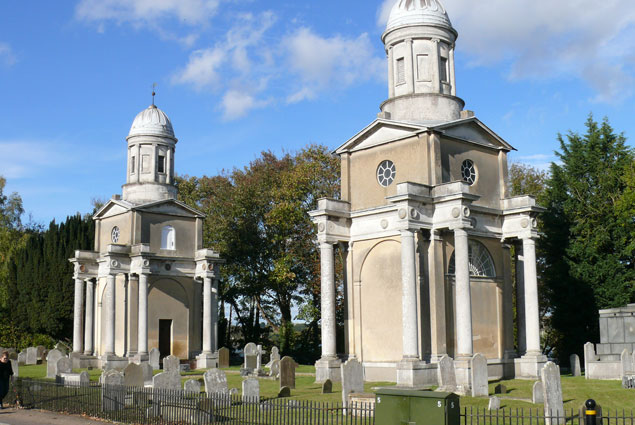
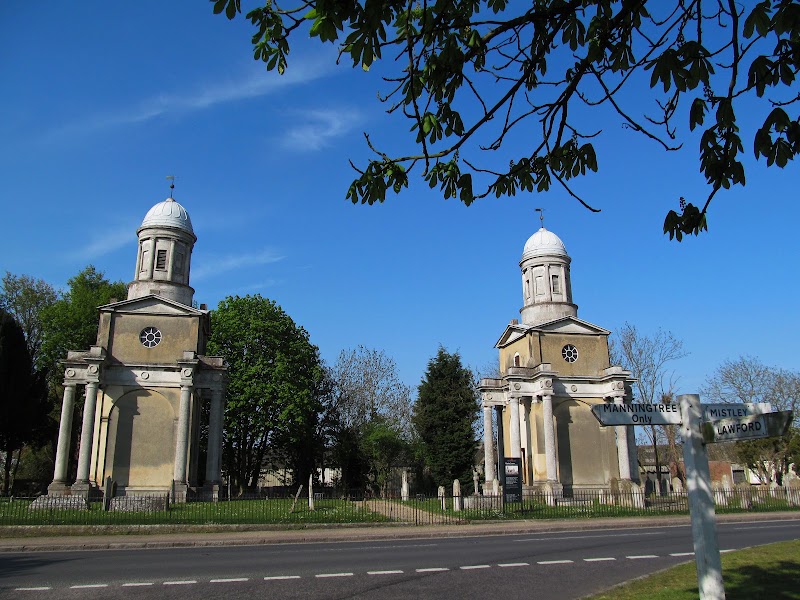
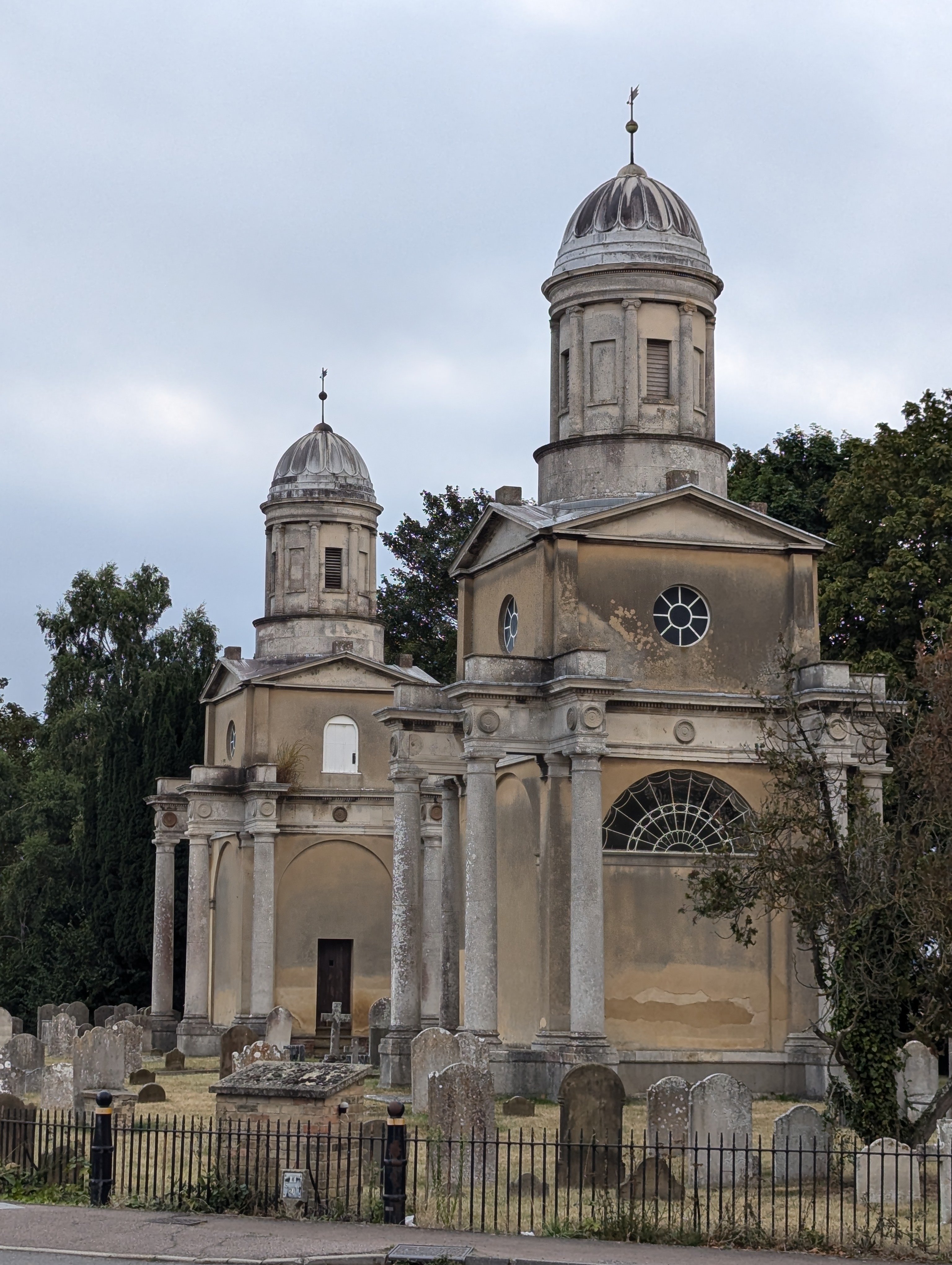
In the 1770s Richard Rigby, Paymaster General and lord of Mistley Hall, set out to rebrand Mistley as a salt-water spa to rival fashionable resorts. He hired the celebrated architect Robert Adam to transform the modest parish church into something that matched his ambitions. Adam’s 1776 scheme produced a strikingly symmetrical building with a tower at each end and curved porticoes on the long sides, one of only two churches he designed. The result is what we now call Mistley Towers, a Grade I remnant of the Adam church that still punctuates the skyline. ([English Heritage][2])
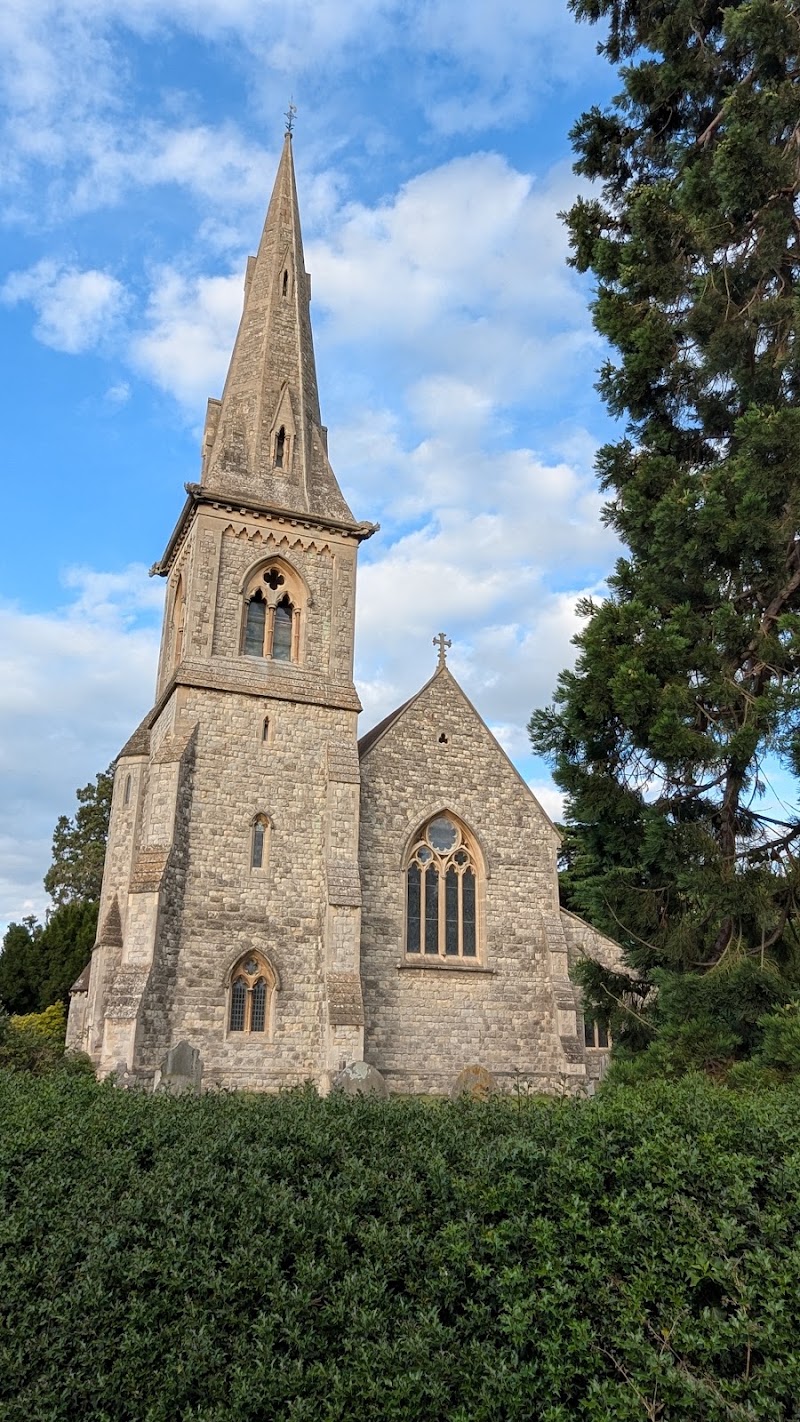
The spa never took off and the Adam church did not last. By 1870 the main body of the building was demolished and a new, larger church was built on New Road in the then-fashionable Gothic Revival style. The twin towers were deliberately kept as a seamark to guide river traffic. They were later repaired in the 1950s by architect Raymond Erith. The present parish church, St Mary and St Michael, is listed Grade II. Reasons given in conservation and listing sources include the need for a bigger Victorian church and the deterioration of the earlier structure by the 1860s. ([English Heritage][2])
The witch hunts that began here
Manningtree and Mistley were the flashpoint for England’s largest witch-hunt during the turmoil of the Civil Wars. In March 1644 Matthew Hopkins, a gentleman newly settled in Manningtree and associated locally with the Thorn Inn at Mistley, claimed he had overheard women speaking of meetings with the Devil. Working with his associate John Stearne, he launched investigations that culminated in the Chelmsford trials of 1645. Twenty-three accused from the area were sent for trial. Nineteen were convicted and hanged, four died in prison. Among the first accused was Elizabeth Clarke, an elderly, disabled widow from the Manningtree side of the parish, whose forced confession under brutal sleep deprivation dragged other local women into the net. ([Wikipedia][3])
Hopkins styled himself Witchfinder General and ranged across East Anglia during 1645 to 1647, but the panic began in Manningtree and the Tendring Hundred. Modern public history projects in Essex refocus the story on the women and communities targeted, rather than the notoriety of the witchfinders themselves, a perspective that is now reflected in local interpretation and walking routes. ([University of Essex][4])
Quays, maltings and a model port
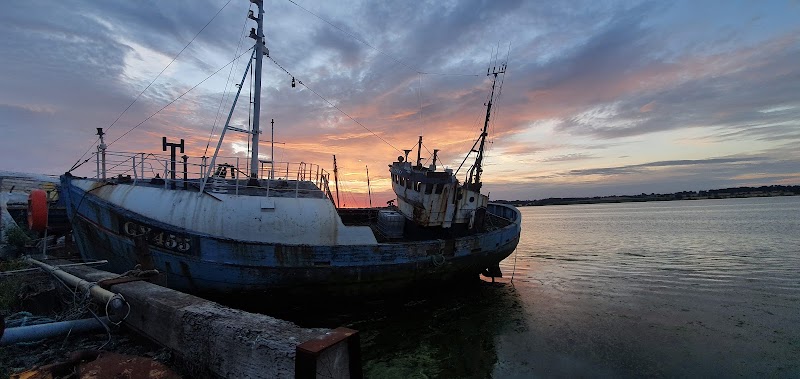
A quay existed at Mistley by about 1720 and was enlarged around the 1770s as the estate was reshaped. The expanded port handled Newcastle coal, Scandinavian timber and a steady flow of agricultural produce from the Stour valley, while malted barley and flour moved the other way for the London market. Travellers in the 1780s noted a lively scene of ships at the quay and described trade as essentially created by Rigby’s investment. Mistley soon developed rows of maltings, granaries and warehouses, with small warships even built at Mistleythorn in the late eighteenth century. ([Wikipedia][5])
The working river had a rhythm. Inland lighters brought grain, bricks and chalk downriver. At Mistley Wharf cargoes were shifted to larger Thames barges for the coastal leg to the capital. The pattern reversed for coal and timber coming in. This meeting of river and sea traffic at Mistley and Manningtree is why the two places became a classic transhipment hub for bulky freight before the railway age. ([tumbarumba.co.uk][6])
From the late nineteenth century the port adapted again, serving the malting industry more directly. The quay wall itself is now protected for its historic interest, and cargo handling continues at the modern port, proof that Mistley’s industrial purpose never entirely faded. ([Historic England][7])
Rails, packets and the age of movement
The railway arrived early. Manningtree station opened on 15 June 1846 on the Great Eastern main line, later becoming the junction for the branch to Harwich, today branded the Mayflower Line. Mistley gained its own station in 1854, with an elegant Italianate building. Rail connections accelerated both freight movements and day trips, knitting these Stour-side places into the wider world. ([Wikipedia][8])
Downriver, Parkeston Quay, now Harwich International, grew into a major packet and passenger port in the late nineteenth century. That traffic reinforced Manningtree’s role as a gateway station and kept the Stour estuary busy with steamers, barges and coasters. ([Wikipedia][9])
Tourism, leisure and identity
Although Rigby’s spa vision failed in the 1770s, leisure returned in other guises. The railway brought visitors to walk the Stour banks and explore what later became known as Constable Country. Modern trail makers have used the witch-trial story and the surviving Adam towers to anchor cultural walks between Mistley and Manningtree. Today the riverside remains a draw in its own right, with birdlife, big skies and heritage features concentrated within a short, very walkable distance. ([Scenic Rail Britain][10])
A very recent chapter has been the community campaign over access to Mistley Quay, culminating in a 2021 Supreme Court decision that upheld its registration as a village green, a reminder that the working waterfront is also a cherished public place. ([Wikipedia][5])
A short chronology
* Medieval period: Parish church by the river at Mistley, later only the porch survives. ([English Heritage][2])
* 1705: River Stour Navigation authorised, opening Sudbury to Mistley and Manningtree to barge traffic. ([riverstourtrust.org][1])
* c. 1720: First recorded quay at Mistley. ([Wikipedia][5])
* 1735: Plain brick parish church built north of Mistley village. ([English Heritage][2])
* 1776: Robert Adam remodels the church for Richard Rigby. Spa plans stall. ([English Heritage][2])
* 1644–1645: Manningtree witch scare sparks East Anglian witch-hunts; Chelmsford trials of 1645 lead to mass executions. ([Wikipedia][3])
* 1846: Manningtree railway station opens on the main line. ([Wikipedia][8])
* 1854: Mistley station opens on the Harwich branch. ([Wikipedia][11])
* c. 1870: Adam church demolished except for the towers; new Gothic Revival parish church, St Mary and St Michael, built on New Road. ([Wikipedia][12])
* 1950s: Mistley Towers repaired by Raymond Erith. ([English Heritage][2])
* 2021: Supreme Court upholds village-green status for parts of Mistley Quay. ([Wikipedia][5])
Why the old church went and the new one rose
To gather the threads: by the mid-nineteenth century the Adam church was unfashionable and increasingly impractical for a growing Victorian parish. Conservation documents record that its main body had deteriorated, and the vogue was for larger Gothic churches with expanded seating and a stronger liturgical focus. The solution was to build a new church on New Road and remove the small, compromised Georgian nave, retaining the distinctive towers as a landmark for river traffic. That is why Mistley today has both a Victorian parish church and, separately, Adam’s photogenic twin towers. ([Historic England][13])
The character of the place today
Walk the short mile between Manningtree High Street and Mistley Towers and you pass most chapters of this story in a single stroll: the river bend where barges once rafted up, the maltings and warehouses, the Adam towers in their churchyard, and the Victorian church a little inland. It is an unusually dense historic landscape, and the river still does much of the talking.
Sources and further reading
English Heritage, *History of Mistley Towers**. Excellent overview of the Adam church, its origins, demolition and later repairs. ([English Heritage][2])
Historic England listings for *St Mary and St Michael, Mistley** and for Mistley Quay wall, for architectural details and the quay’s industrial significance. ([Historic England][13])
* River Stour Trust and navigation histories on the 1705 Act and working of the Sudbury-to-Mistley waterway. ([riverstourtrust.org][1])
* Manningtree and Mistley railway history and the Mayflower Line. ([Wikipedia][8])
* On the witch-hunts: entries on Matthew Hopkins and Elizabeth Clarke, and public-history projects re-centering the victims. ([Wikipedia][3])
* Background on Mistley’s eighteenth-century port, Rigby’s ambitions and later community access to the quay. ([Wikipedia][5])
If you would like, I can tailor this into a printable leaflet or a script for a guided walk between Manningtree station and Mistley Towers, with stops keyed to sights along the way.
[1]: https://www.riverstourtrust.org/about/history/?utm_source=chatgpt.com "History"
[2]: https://www.english-heritage.org.uk/visit/places/mistley-towers/history/ "History of Mistley Towers | English Heritage "
[3]: https://en.wikipedia.org/wiki/Matthew_Hopkins?utm_source=chatgpt.com "Matthew Hopkins"
[4]: https://www.essex.ac.uk/research-projects/snapping-the-stiletto/manningtree?utm_source=chatgpt.com "Manningtree: Revisiting the Essex Witch Trials"
[5]: https://en.wikipedia.org/wiki/Mistley?utm_source=chatgpt.com "Mistley"
[6]: https://www.tumbarumba.co.uk/OTHER%20WALKS/ESSEXWAY/Stage6.html?utm_source=chatgpt.com "Essex Way"
[7]: https://historicengland.org.uk/listing/the-list/list-entry/1413747?utm_source=chatgpt.com "Mistley Quay wall (also known as Thorn or Allen's Quay)"
[8]: https://en.wikipedia.org/wiki/Manningtree_railway_station?utm_source=chatgpt.com "Manningtree railway station"
[9]: https://en.wikipedia.org/wiki/Harwich_International_Port?utm_source=chatgpt.com "Harwich International Port"
[10]: https://scenicrailbritain.com/lines/mayflower-line/?utm_source=chatgpt.com "Mayflower Line"
[11]: https://en.wikipedia.org/wiki/Mistley_railway_station?utm_source=chatgpt.com "Mistley railway station"
[12]: https://en.wikipedia.org/wiki/Mistley_Towers?utm_source=chatgpt.com "Mistley Towers"
[13]: https://historicengland.org.uk/listing/the-list/list-entry/1074933?utm_source=chatgpt.com "CHURCH OF ST MARY AND ST MICHAEL, Mistley"